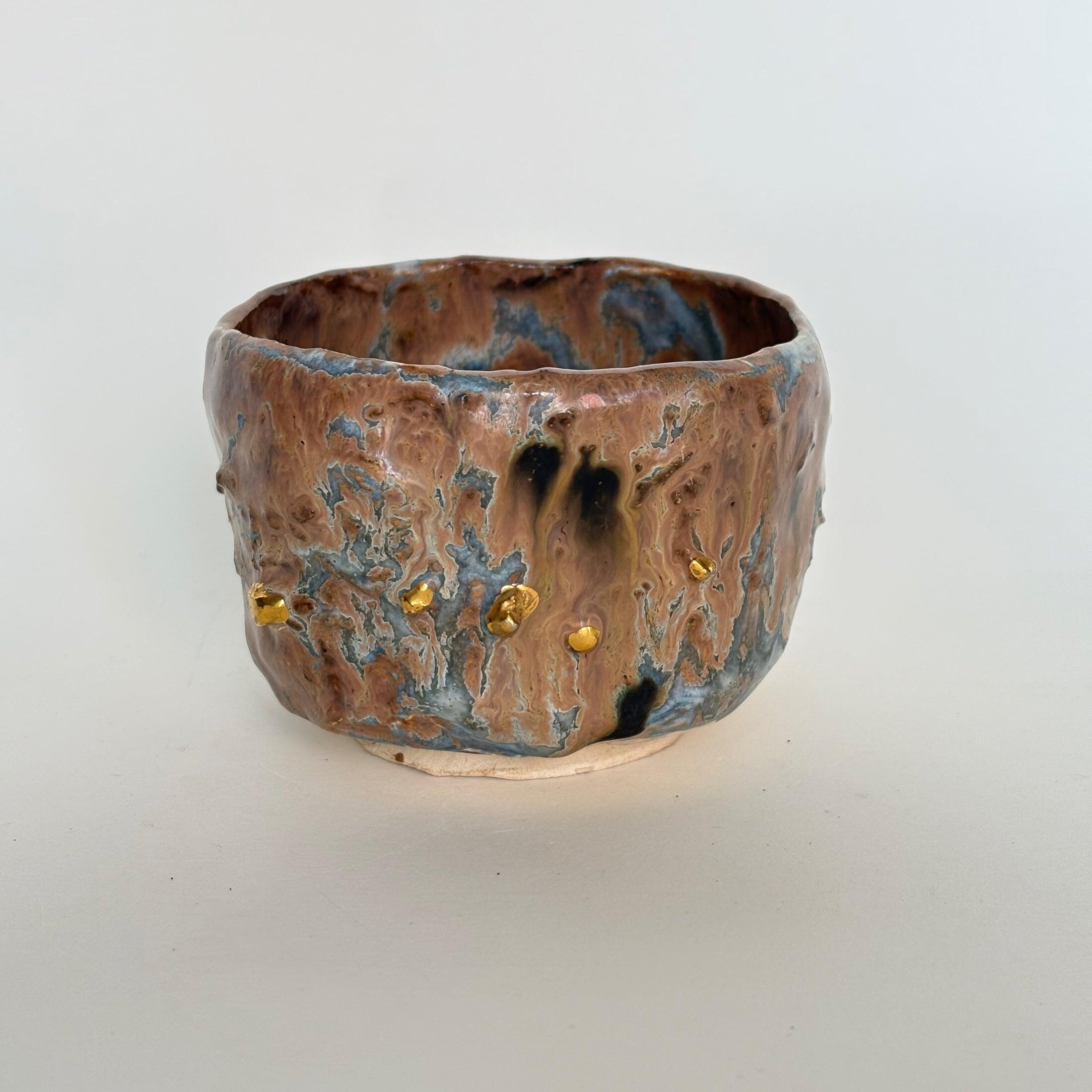
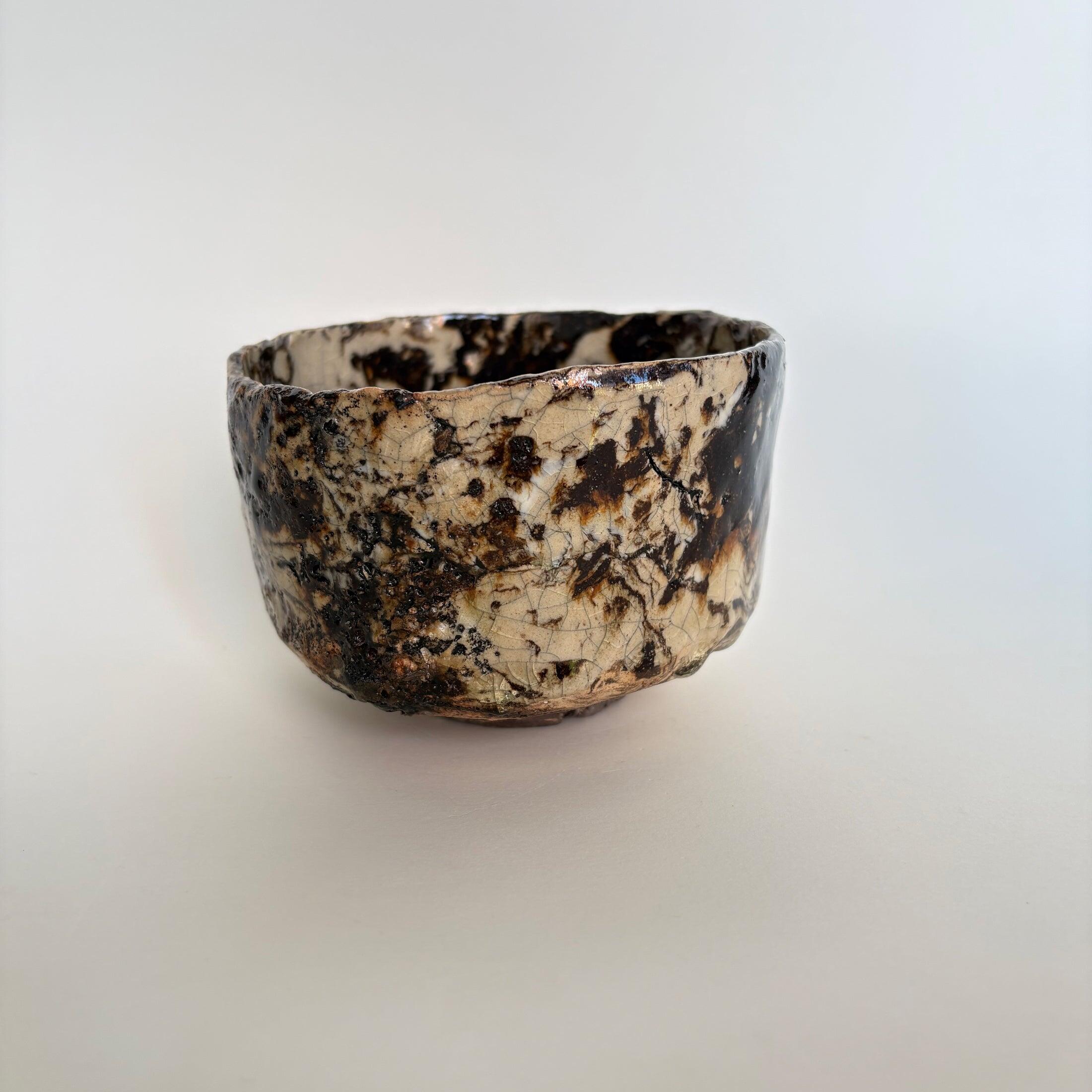

Vessels grew out of Views of my tea (2014 to 2015), a durational micro-performance. I drank 888 bowls of matcha from the same black raku bowl, made by Kyoshitsu Sasaki of the Shoraku kiln in Kyoto, and recorded each one with a single photograph on the same table. It was a very private and very limited version of a tea ceremony. During that project I began to think about making vessels myself. It became possible when Sasaki-san, whom I came to know through the project, introduced me to kurinuki, the Japanese technique of carving a vessel out of a solid block of clay. The first bowl I made was first snow, last snow.
At first there were only a few. Then more and more followed, and today there are hundreds. Each one is shaped by hand, often from clays I have collected and mixed myself, and many are fired several times before they are finished.
From the beginning I was interested in the idea of these vessels spreading around the world. I was also interested in what happens once they are in other people’s hands: everyone who drinks from one, day after day in their own place, is making their own version of Views of my tea, even without meaning to.
Collectors around the world have begun to choose their favourites from the hundreds of vessels I have made. In 2025 two exhibitions were dedicated to the work: Star Resonance in Lisbon and Vessels in Berlin, both showing mainly small vessels for sake. Parts of the sculpture have since been shown in Shrewsbury and Lisbon.
Today there are vessels in collections in Kyoto, Beijing, London, Warsaw, New York and Los Angeles. Most are currently in Berlin and Lisbon, and that will change as the work continues. Like many of my durational projects, Vessels is still ongoing, and now that the nature of these highly individual vessels for drinking is public, I expect them to travel much further.
What began as a tea ceremony for one person at one table now lets hundreds of people drink whatever they choose, in their own ways and in their own places.
This openness was inspired by a line I have carried with me for years, adapted from chapter 66 of the Tao Te Ching: “The ocean is only so powerful because it accepts all rivers and never puts itself above others.” Unless someone decides to be a rebel, every use of a vessel repeats this. The vessel has to be empty, and it has to be placed lower than what pours into it. Then it gives what it has received to the person who drinks.
This is why I think of the most important part of a vessel as the part that has no material at all: its void. The Tao Te Chingsays it in chapter 11. We shape clay into a vessel, and its use comes from the emptiness inside.
By distributing one sculpture across the continents, I am creating a connection between its parts that can help the people who hold them understand how everything is interconnected. The Daoist philosopher Zhuangzi put it this way: heaven and earth were born together with me, and the ten thousand things and I are one.
Because the vessels are small, it is almost as if they were entangled particles, each with its own destination, function and destiny, performing very similar acts at seemingly random moments.
Vessels is also a collaboration with nature. The vessels are made from the earth, and every beverage poured into them has come from the earth too, or from plants that grew on it. Each time someone drinks, the earth holds what the earth has given.
I hope the people who use the vessels take a moment to contemplate this. Theodor W. Adorno and Max Horkheimer wrote of the Eingedenken der Natur im Subjekt, the remembrance of nature within us. A single cup can be a small, daily practice of it.
The vessels travel. Some will break, and many will outlive the people who hold them. This connects the work closely to my series Collaborations with Earth (since 2025), in which ceramic objects are placed and buried in locations around the world. Sooner or later they will return to the earth. How long that takes will vary widely and cannot be predicted.
The life of a vessel does not end when it breaks. It can be returned to me, repaired, or placed in the earth.
Every vessel has passed through my hands, and many took a long time to make. Yet the work is designed to be distributed widely, and it can never be entirely in the possession of one person or organisation. Some places will hold more vessels than others, but this is a global work, and in the end it needs to show that the world has no centre. The sculpture can be used almost anywhere, by almost anyone.
There is a mix: many vessels have been given as gifts, and many have been bought. Buying one directly supports a living artist and the continuation of the project. This mix of gifts and purchases, of exchanges and encounters, gives the work its strength and shows the resilience of our collaborations.
Many works connect to this one and have inspired it. Joseph Beuys’s 7000 Oaks (Kassel, begun at documenta 7 in 1982 and completed in 1987) comes to mind, and Felix Gonzalez-Torres’s deeply moving “Untitled” (Portrait of Ross in L.A.)(1991), a pile of candy whose pieces visitors take with them. Clare Twomey has made exceptional ceramic work built on wide participation, such as Exchange (Foundling Museum, London, 2013), in which visitors kept a cup in return for doing a good deed. Rirkrit Tiravanija’s works in which people share a meal, such as Untitled (Free) (303 Gallery, New York, 1992), are a connection too, despite the very different scale. And Agnes Denes’s Tree Mountain: A Living Time Capsule(Ylöjärvi, Finland, 1992 to 1996), where 11,000 people each planted a tree and became its custodian for 400 years, shows how one work can be held by many people across generations.
Hans Ulrich Obrist has said he is struck by “how many artists are moving toward long-duration projects,” work that outlives the exhibitions it appears in and often unfolds in the living world, beyond the museum (Artsy, January 2026). My own practice has been moving in this direction for more than a decade, from Views of my tea (2014 to 2015) to Vessels (since 2019) and Collaborations with Earth (since 2025).
We are building a way for owners to place their vessels on a map as anonymised markers, so that the reach of the work can be seen as it grows. The map will probably not outlive the project itself, unless someone takes real care to keep it.
You may already be part of this work. If you are not, and would like to be, get in touch with me or with Atelier Boa Hora to find your part in it.
 Next Project